It's
such luck I am still alive
because I can swear to its
untruth. If I were dead, as
most people are at my age, who
could be
certain?
| [images added by this
website] The
Independent London, Sunday, August 17,
2003Focus:
Diana
Mosley - The last bright young
thing AS
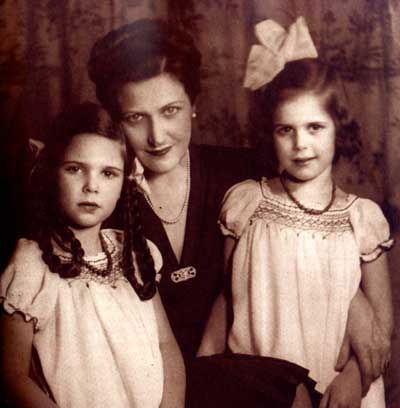
Diana Mitford she was the most
glamorous of her famous family. As
Diana Guinness she was at the
centre of Twenties society. And as
Diana Mosley, through her fascist
husband and friendship with Hitler, she
became a pariah.
After being
imprisoned for three and a half years
during the Second World War she and Oswald
Mosley moved to France, where she remained
until her death last week at the age of
92. In her final interviews, she told
Duncan Fallowell about her
extraordinary life T
IS spring 2002. Her flat is in the
Septième district, the Mayfair of
Paris, on a corner overlooking a large
garden with grass and trees. There are
French windows on two sides and the
sunshine makes patches on Empire cabinets
and comfortable sofas. A tall, slim,
upright woman, dressed in beige wool,
brown suede shoes, and pearl earrings is
walking towards me with hands
outstretched. "Have you come all the way
from Saint Tropez?" "No, from London."
- "You must be so tired."
- "No, I came on Friday
evening."
- "How clever. What will you have to
drink?"
She has a wide smile, which seeps
upwards into soft, eau-de-Nil blue eyes.
And she's full-on. Can this really be
Diana Mosley, 92 years old this year, once
the most beautiful woman in England, then
the most amusing, the most notorious, and
eventually the most hated? More than 50
years of exile in Paris don't seem to have
done her a great deal of harm. Once upon a
time everyone knew the outline of her
story. But fewer do these days, so here it
is again. She began as a Mitford, sister
to Nancy, Jessica, Debo, Unity, Pam, Tom.
At the age of 18 she married rich Bryan
Guinness, and they became the star
couple of the late 1920s and early 1930s.
Evelyn Waugh described their milieu
in his second novel, Vile Bodies,
which he finished while staying with them
in Bryan's parents' flat at 12 rue de
Poitiers - only a couple of streets from
where we are today. Waugh dedicated the
novel to them both, "with love", then
promptly fell out with Diana and didn't
talk to her again for 25 years. Notoriety came in the 1930s. She
attended the Nuremberg rallies with her
sister Unity, who introduced her to
Hitler. Diana fell in love with the
leader of the British Fascists, Sir
Oswald Mosley (baronet), her adored
"Kit". After divorcing a devastated Bryan
she set up in Belgravia as a single mother
with her two young Guinness sons, Jonathan
and Desmond. In 1936 Diana and Unity were
the personal guests of Hitler at the
Berlin Olympic Games. In the same year
Diana secretly married Mosley in
Goebbels' drawing-room in Berlin -
Hitler was guest of honour. This was
through her friendship
with Magda Goebbels (left),
who was the first lady of the Third Reich,
Hitler being unmarried. Mosley and Hitler
didn't click (this was one of only two
occasions they ever met). Diana had two sons with Mosley:
Alexander and Max. At the outbreak of the
war Unity shot herself in Munich - she
never really recovered and died in 1948.
Diana was left as the only person in the
world on terms of personal intimacy with
both Hitler and Churchill (who had
married her father's cousin). But events
had moved beyond her. In 1940 Mosley was
arrested and imprisoned. Several weeks
later so was Diana, and she spent three
and a half years of the war in Holloway.
What was the effect of all this on her
four sons? "The two who were at school were called
Guinness - so that helped. But Max and
Ali, oh I'm sure they must have suffered.
No school would take them, so we got a
tutor, and later on Ali went to school in
Paris and Max in Germany." "Has their relationship with England
been soured?" "Certainly not with Max. I
think Ali does prefer France. When Max was
at school in Germany not long after the
war, the school inspector came round and
asked each boy a few questions, always
including: 'What was your father's
profession?' When they came to Max he
answered 'Faschistenführer'.
They were very cross with him - and not
unduly." There were, in addition, her
three step-children from Mosley's previous
marriage. The eldest is the present Lord
Ravensdale, better known as the novelist
Nicholas Mosley. "I'm furious with
him now. The books he wrote about his
father were so disloyal." Lord Ravensdale, of course, does not
accept that. The two of them long battled
over the issue but have now given up
trying to speak to each other. - "Oswald Mosley had an affair with
his dead wife's sister," I venture,
tentatively.
- "With both of Cynthia's sisters I
think," Diana informs me.
- "This must have been very shocking
for you."
- "Well, not really. I think it's
very common."
- "But you were still young - he was
your new love - you surely found it
painful."
"Only marginally. I think if you're
going to mind infidelity, you better call
it a day as far as marriage goes. Because
who has ever remained faithful? I mean,
they don't. There's passion and that's
it." "You're obviously not a jealous
person." "Not very, no. I might be jealous of a
deep friendship, something like that. But
not sexually jealous. Kit and Baba always
had this thing for each other, and it's
life. And with sex, opportunity is so
important." "There's always plenty of
opportunity!" - "No, there isn't. Not always."
- "Did you have any amours after Sir
Oswald?"
"Ah, well, like Wilde I can
resist anything except temptation - but I
was never in the slightest degree
tempted." Lunch has begun, served by the maid at
a table at the other end of the
drawing-room. Diana had said: "I invited
Jean-Noël to join us. I hope you
don't mind, because my hearing is so bad
and he can help." Which he has been doing,
sometimes by shouting what I've just said
or by writing it down. Jean-Noël is
in his thirties with thick black hair
which flows upwards. Later on he says:
"Diana is my best friend. I visit her
three or four times a week." The first course was tomato and
mozzarella salad and now we're tucking
into roast chicken with vegetables. Well,
I am - the other two eat very
modestly. There's a feature I haven't seen on a
private lunch table for many years: finger
bowls, in emerald glass. Beneath the table
is a smart rug of black and white
diamonds. "What is your favourite thing in this
room?" "My clock and barometer." She indicates
the French gilt pair hanging on the wall
opposite the windows. "They belonged to my
great great grandfather really - but I
bought them at one of my father's many
sales. He was always having to sell things
and always at the bottom of the market." The voice is not plummy, is not the
Oxford or Bloomsbury drawl, but the perky
cut-glass deb voice of the 1920s and
1930s. It is very clear, and she has
almost flawless grammar besides. Cheese -
Diana doesn't have any - and green avocado
salad are followed by a superb chocolate
flake with lozenges of gold leaf on top.
After coffee we decamp to the sofa.
"There's a new book saying Hitler was
homosexual." "I'm sure he was not homosexual -
because that sort of thing I do more or
less understand." (Diana has always had
gay
[homosexual]
friends, from Lytton Strachey
onwards.) "With someone like General
Montgomery - it may well have been
unconscious - but all the ADCs and other
people around him were very good-looking
young men. And I believe it was the same
with Kitchener. Well, now,
Hitler's
adjutants
(right) were sort of ..." "Ugly." "Gnarled old men, they really were.
They were very, very sweet but I'm afraid
not the least bit good-looking. That just
is the answer really, these were the
people Hitler loved being with." "It's widely
accepted now that his relationship
with Eva Braun wasn't sexual either." "One can't be utterly sure about anyone
- except oneself. But I don't think sex
was a big appetite in him." "Which is strange. Because very
powerful men are usually very sexual too.
Was he like a eunuch?" "Like a eunuch? No, but, well, there
was no question of anything between him
and me but, you know, one can still feel
it - and with Hitler one couldn't." Unity
Mitford calculated that between 1935 and
1939 she met Hitler 140 times. She
introduced him to the rest of the family.
Their mother explained to Hitler the value
of wholemeal bread. And how many times did
Diana meet him? "Not as many as Unity. But ever so many
times." "I wish he'd been something," I
say. "He might not have murdered so many
people. Don't you think it would have been
better for Europe if Hitler had had a sex
life?" "Yes, it might have been but what about
old Musso, who had a terrific sex
life?" "Exactly. Compared to Hitler he was
hopeless at destroying people." "He was
made hopeless because he had a very
unsoldierlike population. They didn't
follow him. However, he was all for
setting everything on fire, wasn't
he?" "Is it true that Hitler used to do
comic impersonations of
Mussolini?" "Quite true. Hitler could be very,
very, very funny." "At the end of the war,
when the newsreels of the death camps
appeared at the cinema, what was your
reaction?" "Well, of course, horror. Utter horror.
Exactly the same probably as your
reactions." "Why didn't you have a revulsion
against Hitler because of this?" "I had a
complete revulsion against the people who
did it but I could never efface from my
memory the man I had actually experienced
before the war. A very complicated
feeling. I can't really relate those two
things to each other. I know I'm not
supposed to say that but I just have to."
DIANA is one of the people who cuts across
our loyalties and preconceptions. Her
disregard for public opinion is very
attractive but it has prevented her
rehabilitation. She alone from that time
refuses to let us dismiss Hitler as pure
evil. Hitler has his human side, she
insists. He was one of us. This makes him
even more frightening, which may not be
what she intended. The classic nightmare -
the friendly face turns into a monster -
is something she refuses to have. Perhaps
at some level there is a conflation
between Hitler and her husband. Oswald
Mosley used to strut around in a black
costume of his own devising. He was the
Errol Flynn of British politics, except of
course he wasn't acting. To reject Hitler
would be to reject her husband, and that
she cannot do. This was probably burned
into her during those years in
Holloway.
- "Going to prison turned out to be
quite a surprise," she says.
- "In what way?"
- "It went on and on. Three and a
half years is a helluva long
time."
- "But it must have made you
strong."
- "How?"
- "To know that you could do
it."
"Of course there's prison and prison. I
mean I wasn't tortured." After 18 months
her husband was transferred to Holloway to
be with her. "All we had was an enormous
wall, a tree, and sort of asphalt. Then
Kit and the old man who was in prison with
us made a marvellous garden and we grew
fraises des bois, which do very
well in soot." Her sister Jessica and Nancy
Cunard were among those who protested
against her release. "Did the Nazi movement attract you in
the 1930s?" "Not particularly, no. It was
Unity who was absolutely overwhelmed with
the heavenliness of it." - "Did you ever have a black
shirt?"
- "Did I ever have a black
child?"
- "Shirt!"
- "A black shirt!" Jean-Noël
backs me up.
- Gales of laughter. "No. I wasn't
really a militant."
- "Did you not think the Nazis were
vulgar?"
"Well, you see, it was a complete
revolution. Do you call that vulgar? It
was also a choice at the time between
fascism and Communism. I am very
anti-Communist. They made a miserable life
for almost everyone." The question of
vulgarity lingered, for in a subsequent
letter she elaborated the point: "I
thought about the vulgarity of National
Socialists. They were never vulgar in the
way, for example, a Tory conference with
ladies in hats singing Wider Still and
Wider, is. I think the answer may be
music. My brother, a very musical man,
used to say it's so unfair, they've got
all the best tunes. Which, of course, for
marches and anthems they had. When Hitler
made an important speech at the closing
session of the Parteitag, a marvellous
orchestra would play a Bruckner symphony
before he spoke, with the world's press
anxious to hear what he was going to say.
The choice of music was so un-vulgar." Though never publicly dissociating
herself from Hitler, she did once say to
Nicholas Mosley that Hitler ruined her
life. "I said it only because I got fed up
with being asked why I didn't hate Hitler
enough. He ruined my life in that Hitler
really began the war - though he was
pushed into it. To me the biggest atrocity
of all was the war. I'm as near a pacifist
as makes no difference. So it would be
truer to say that the war ruined my life.
But again, not really. I've had a very
good life as well. Lots of lovely times
since then." "What makes you feel guilty, generally
speaking?" "I don"t feel terribly guilty,
actually. I don't suffer from remorse.
What I suffer from is when things go wrong
for the people I love. That I can hardly
bear." After the war the Mosleys farmed for
five and a half years in the English
countryside. They were refused passports
and so had to borrow a boat to escape to
their next destination, which was Ireland.
Then to France, to a house on the edge of
Paris called le Temple de la Gloire. The
British Embassy ostracised them. "There was a complete ban on us from
the beginning. One ambassador in the early
1970s did invite us. He just didn't
realise. So we accepted, and about three
days later the poor man had to withdraw
the invitation. He'd discovered we were on
the Foreign Office blacklist." "And
now?" "They still don't. I should feel I'd
done something awful if I suddenly got an
invitation!" The Mosley name was poison after the
war, but not to such an extent that they
felt obliged to change it. When I
mentioned this on a fax she replied: "I laughed at the idea of changing our
name. I was so proud of my husband,
especially the fact that Mosley opposed
the war which so reduced our country that
it cannot be compared with the England of
my youth." Diana has always said that her
brain tumour, which developed soon after
her husband's death in 1980, helped her
deal with the shock of losing him. Even
her appearance on Desert Island Discs in
1989 was highly controversial. Its
broadcast had to be rescheduled several
times because it kept coinciding with
Jewish holy days. And yet despite her
questionable past, Diana continues to make
unlikely friends and keep them. She is
extremely considerate, very clever and a
terrible tease. Her warmth of personality
is captivating. - "To what do you attribute your
longevity?"
- "Oh. It must be the genes, mustn't
it."
- "And your other strengths?"
"Love of life. And in a way -
contentedness. I'm not discontented. I've
no reason to be now but I have had in the
past." "Would you have preferred to end your
days in England?" "I don't care where it
is as long as it's quick! The Greeks said
that all death is good provided that it is
sudden."
WE meet again a year later in the spring
of 2003. After another delectable lunch -
my goodness, this woman does know how to
entertain - we retreat to the sofa by the
window.
"How did you come to meet Evelyn
Waugh?" "He was a friend of my first husband at
Oxford. There were a group of them. We
were all tremendous friends from the end
of 1928. You should remember that in 1930
I was only 20. I was very fond of
Harold Acton, Evelyn Waugh, John
Sutro, and a little later of John
Betjeman. I think those were the ones
we loved." "Vile Bodies was finished in
that flat round the corner here, wasn't
it?" "I was pregnant with my first son so we
came to Paris in the autumn of 1929. My
parents-in-law had this flat which they
never used, marvellous servants in it, a
wonderful cook. So we borrowed it and had
people to stay, my sister Nancy, Evelyn,
they were all writing books. My husband
was writing one too." "How long was Waugh
with you in Paris?" "I should think a fortnight. Not long.
We were always on the move in those days.
Evelyn's first marriage had broken up - or
it was just happening. He was so cheerful
and full of jokes that one could not
imagine that he was suffering, but
apparently underneath he was. His first
wife was a pretty little person, but I
think quite silly." "Did he change after his divorce?" "He did. Vile Bodies was his
first success and success changed him but
what really changed him was religion." "The break with Waugh - there's
something not quite right - he contrived
it perhaps." She shrugs, sighs, puts her head on one
side, and looks at me with those limpid
eyes. "We were such great friends. I
couldn't go out much because I was going
to have the baby. Towards the end of that
period he was more or less the only person
who came to dinner. Of course the moment I
was free from the baby I wanted to rush -
you've got to remember I was only 19."
"You married and started a family early.
Would you like to have had a career?" "Not really. I"m too lazy. And a lot of
the places I rushed, Evelyn probably
didn't know the people. He'd become very
possessive and got terribly cross and
started saying you can't have so-and-so to
dinner. Everything I did was wrong. Since
I had a lot of people who thought what I
did was all right, I preferred to see
them. One doesn't want somebody carping
all the time. But I missed him very
much." - "After the war he explained that it
was because he'd fallen in love with
you."
- "Yes."
"But it feels more social insecurity
than infatuation." "A bit of both. When I
came to write my memoirs I thought: why
was there a rift? I wrote to him and he
said it was jealousy. I wrote back and
asked why was it jealousy, and he said I'd
put Robert Byron and Harold Acton above
him. Well, it wasn't true." By the end of
1930 it was all over, "though we kept
noticing each other at parties, sort of in
the distance". "Did you meet him properly
again?" "After the war we occasionally lunched
together. Never a cross word, I'm glad to
say. When we were living in Wiltshire I
had to go up to London for the dentist. We
had Gerald Berners staying with us,
who was furious with me for going to
London for the whole day. When I got back
he was on the doorstep and asked: 'What
did you do?' and I said: 'I lunched with
Evelyn, who told me that he prays for me
every day.' And Gerald said: 'God doesn't
pay any attention to Evelyn'." Diana is wearing a white polo-neck
sweater and a black wool suit with jet,
brass-ringed buttons. Was Givenchy her
favoured couturier? "Yes. Balenciaga was
greater but he was long beyond my purse -
very expensive - but I had heaps of
second-hand things by him, and used to
parade very successfully in those." "So Givenchy was less expensive?" "Yes, Givenchy had a boutique. I never
bought clothes from what they call
upstairs, which was the expensive part.
But in the boutique you could choose
something and they'd give you a fitting,
or even two. Debo had heaps of things from
him and I had quite a few and do you know
I still wear them - they haven't dated at
all. If I put on something Hubert has made
I always feel in the height of
fashion." "Well, you are. All these Mitford books
and Mosley books. It's getting out of
hand. And there's a new biography of your
second husband coming. The author says
that, contrary to what was always claimed,
the British Fascists did receive funding
from the Nazis before the war - and that
the courier of the money was you." "What we did do was try to set up this
commercial radio station in Germany, but
the war put a stop to that. As for the
money I am supposed to have carried from
Berlin to the British Union of Fascists,
it's just another lie. It's such luck I am
still alive because I can swear to its
untruth. If I were dead, as most people
are at my age, who could be
certain?" © 2003
Independent Digital (UK)
Ltd 
David
Irving: A Radical's
Diary
[Death
of Lady Mosley]
Daily Telegraph and other
obituaries
|